

Local journalism in America is unraveling, often silently. Over 50 million Americans now live in areas with limited or no local reporting, creating “news deserts.” The consequences extend beyond missing headlines — communities lose accountability, civic cohesion, and democratic engagement. Understanding this crisis is essential for sustaining informed, vibrant towns.
The Silent Crisis: Why Your Town Might Be a “News Desert”
Across the U.S., local newspapers are disappearing — often without fanfare. Two or more small-town newspapers close every week, leaving residents without reliable news. This “local news collapse” is more than a journalism problem; it threatens democracy, civic engagement, and the very sense of community.
A “news desert” refers to a geographic area where residents lack meaningful access to original local reporting. According to the Northwestern University Medill School of Journalism, 213 counties now have no local news outlet, while another 1,524 counties have only one. That totals almost 50 million Americans living with severely restricted access to local news. (localnewsinitiative.northwestern.edu)
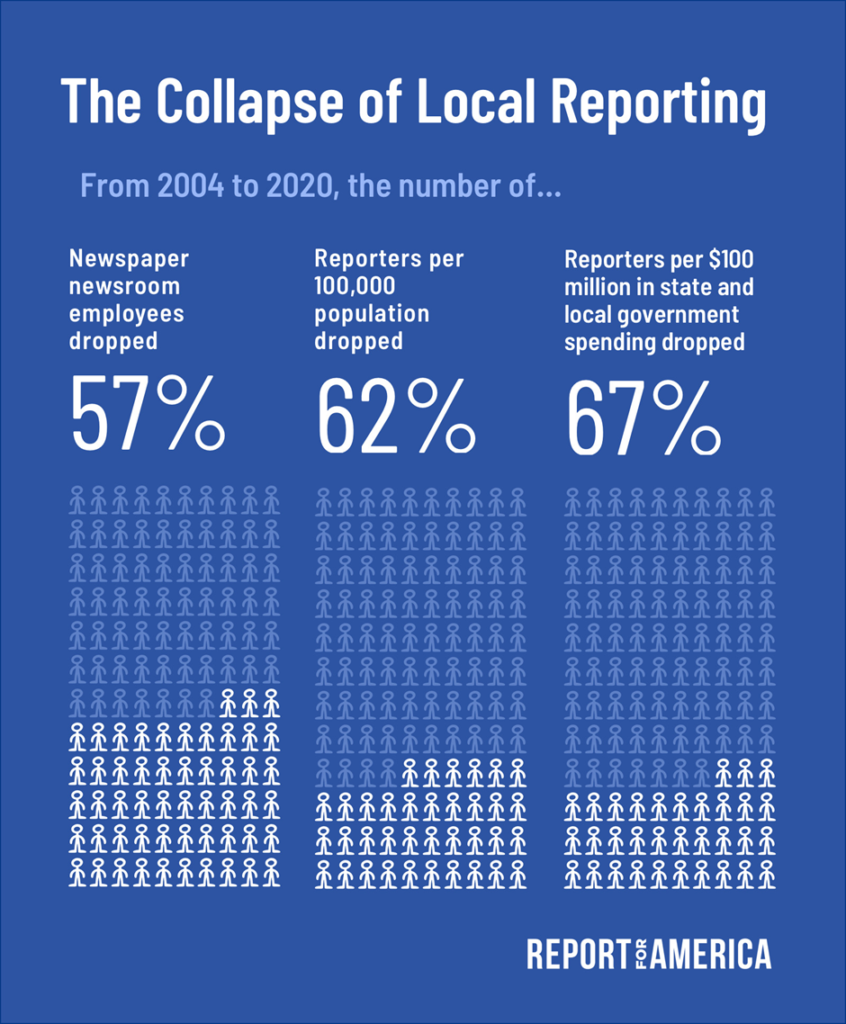
Why Local News Is Collapsing
Economic Pressures
● Traditional advertising revenue has plummeted as digital platforms dominate, leaving small newspapers financially vulnerable. (poynter.org)
● Since 2005, nearly 3,500 newspapers have shuttered in the U.S. (localnewsinitiative.northwestern.edu)
● Newspaper employment has dropped dramatically, with over 75% of newsroom jobs disappearing since 2005. (medill.northwestern.edu)
Ownership Consolidation
Corporate buyouts are absorbing independent newspapers, often diluting their local focus. In one recent year, 258 newspapers changed hands, usually moving from local ownership to regional or national chains. (news.northwestern.edu)
Demographic & Geographic Factors
● Rural areas are particularly vulnerable, but urban and suburban counties have lost hundreds of papers as well. (niemanlab.org)
● Counties with average household incomes below ~$54,000 are more likely to become news deserts. (governing.com)
● Predictions show more than 250 additional counties at high risk of losing their local news infrastructure within the next decade. (localnewsinitiative.northwestern.edu)
Digital Transition Isn’t Enough
Although hundreds of digital-only outlets have emerged, they are largely concentrated in urban areas and rarely replicate the original, in-depth reporting of traditional newspapers. (localnewsinitiative.northwestern.edu)
Many are under five years old and struggle to sustain operations. (informedfutures.org)
Why This Matters: Civic and Community Consequences
● Reduced Accountability: Fewer journalists monitoring local governments allow corruption and mismanagement to go unchecked.
● Erosion of Community Cohesion: Local papers provide a shared narrative, connecting residents and fostering community identity.
● Lower Civic Engagement: Studies show that communities without local news experience decreased voter turnout and civic participation. (apnews.com)
● Misinformation Risks: Residents increasingly rely on national outlets or social media, often with limited or skewed coverage of local issues.
Real-Life Examples
● Milwaukee: Over the last two decades, 80% of local papers have closed. (niemanlab.org)
● Columbus, Ohio: Lost more than 45 local titles, a 74% decline in local newspaper coverage. (niemanlab.org)
● Mississippi Counties: Entire counties are left without a single independent local newspaper. (localnewsinitiative.northwestern.edu)
● Public Media Strain: In some areas, public radio is the only remaining source of local news, often under financial threat.
Solutions and Hope
● Local Journalism Startups: Over 300 new outlets backed by philanthropy are experimenting with sustainable models. (medill.northwestern.edu)
● Bright Spot Programs: Certain outlets demonstrate success with innovative funding, hyper-local focus, and digital integration. (drt.cmc.edu)
● Policy Advocacy: Pushes for tax incentives, nonprofit support, and public funding to sustain small outlets. (poynter.org)
● Community Engagement: Schools, nonprofits, and civic groups partner to produce local news cooperatively.
What You Can Do
● Subscribe & Support: Pay for local journalism to keep it viable.
● Advocate: Urge local leaders to back policies that support journalism.
● Volunteer: Help write, edit, or distribute local news content.
● Partner: Collaborate with schools, civic groups, and nonprofits to bolster local reporting.
● Spread Awareness: Use social media and community forums to highlight the importance of local news.
FAQs About Local News Collapse
- What is a news desert?
A geographic area with little or no original local news coverage. (localnewsinitiative.northwestern.edu) - How many counties are news deserts?
213 counties have no local news outlet; 1,524 counties have only one. - How many newspapers have closed recently?
136 newspapers closed in the past year alone. - Who is most affected?
Both rural and urban/suburban communities are impacted. - Why can’t digital outlets replace traditional news?
They are often under-resourced and concentrated in urban areas. - What happens to civic engagement?
Communities without local news see lower voter turnout and less participation. - Are there successful new models?
Yes, 300+ startups with philanthropy backing are emerging with innovative approaches. - Is public media a solution?
It helps but is often underfunded and cannot cover every local story. - Can policy help save local news?
Yes, through public funding, nonprofit support, and tax incentives. - What can citizens do?
Subscribe, donate, volunteer, and advocate for strong local journalism.
Why This Matters
Local news is critical to democracy. Without it, residents lose oversight, civic engagement drops, and misinformation spreads. Supporting and rebuilding local news infrastructure isn’t just about journalism — it’s about sustaining democracy itself.